

Progesterone, Explained Without the Spin: The Hormone With Two Very Different Jobs
Anyone researching menopause hormone therapy eventually runs into the same confusing split. One corner of the internet talks about progesterone like a wellness cure-all: calming, natural, gentle. Another corner, usually the medical literature, treats it almost clinically, folded into discussions of endometrial risk and clotting factors. Both descriptions are technically drawing from the same hormone. Neither one, on its own, explains what progesterone is actually for.
The clarification is simpler than it sounds. Progesterone does two distinct jobs in the body, and most of the confusion online comes from people talking about only one of them at a time. This piece lays out both jobs, what the evidence actually supports for each, and how that translates into a sensible path if a clinician has raised progesterone as part of a treatment plan.
One note before getting into it: progesterone is a prescription hormone. Oral micronized progesterone is FDA-approved under the brand name Prometrium [1]. Whether it’s needed, and in what dose and form, depends on individual history, which is exactly why the specifics vary so much from one person to the next.
The confusion: what is this hormone actually for?
Progesterone is produced naturally in the body, mostly by the ovaries in the second half of the menstrual cycle, and in much larger quantities by the placenta during pregnancy. The name gives it away: pro-gestation, the hormone that supports carrying a pregnancy. That’s job one, and it’s the job almost nobody discusses in the context of menopause care, because it isn’t the reason a clinician prescribes it later in life.
Job two is the one that actually matters for hormone therapy. Estrogen builds up the lining of the uterus, thickening it over time. Progesterone acts as the counterweight: it stabilizes that lining and, absent a pregnancy, allows it to shed in an organized way rather than overgrowing unchecked. A useful shorthand: estrogen grows things, progesterone keeps the growth orderly and knows when to call it. That single relationship explains most of why progesterone shows up in menopause prescriptions at all.
There’s also a word that causes more confusion than it should: bioidentical. Micronized progesterone, the kind found in Prometrium and in most compounded preparations, is chemically identical to what the body produces. That’s an accurate statement, and it matters, because it’s a different molecule from older synthetic progestins like medroxyprogesterone acetate, which mimic progesterone’s effects without being the same compound. So “bioidentical progesterone” is chemically correct. What that phrase does not tell anyone is anything about dose reliability or regulatory oversight, and that distinction comes back later.
The clarification: why it’s almost never given alone
Here’s the central fact of this entire topic. When a woman who still has a uterus takes estrogen without progesterone, the uterine lining can overgrow, a condition called endometrial hyperplasia, which left unaddressed can progress toward cancer. Progesterone prevents this by providing the counterweight described above. This is the reason a woman with a uterus is almost never prescribed estrogen alone.
The evidence behind this isn’t soft. The Postmenopausal Estrogen/Progestin Interventions (PEPI) trial, published in JAMA in 1996, randomized postmenopausal women to placebo, estrogen alone, or estrogen paired with various progestogens, including oral micronized progesterone. Women on estrogen alone developed hyperplasia at dramatically higher rates. Women who added a progestogen, including cyclic micronized progesterone, had hyperplasia rates close to the placebo group [2]. That’s randomized trial data, the strongest kind available, and it’s exactly why the FDA-approved Prometrium label lists “prevention of endometrial hyperplasia in postmenopausal women receiving conjugated estrogens” as an approved use [1]. If only one fact from this article sticks, this is the one worth keeping: estrogen without adequate progesterone is genuinely unsafe for a woman with a uterus, and lining protection is progesterone’s best-supported role.
Grading the other claims, honestly
The endometrial story is the medically load-bearing one. It’s not, however, what most people ask about. The questions that actually come up are about sleep, calm, and breast safety. Each deserves a straight answer, and the honest answer differs by category.
Sleep. This one holds up, with the caveat that “holds up” means modest, not dramatic. A 2021 systematic review and meta-analysis in the Journal of Clinical Endocrinology and Metabolism examined micronized progesterone and sleep, largely in postmenopausal women, and found improvements in several aspects of the sleep cycle and self-reported sleep quality, though the effect wasn’t uniform across every measure studied [3]. The common real-world pattern, someone taking their oral dose at bedtime and noticing better sleep, has actual trial support behind it. What it doesn’t have is evidence that progesterone functions as a general insomnia treatment. It’s a genuine secondary benefit within the menopause context, not a substitute for a sleep medication.
The calming effect. Many women report a settling feeling, often tied to that bedtime dose and the sleep improvement. It’s plausible, commonly described, and overlaps with the sleep data rather than standing as its own separately proven effect. Calling it a proven anti-anxiety treatment would overstate what the trials were built to measure. Calling it a widely reported experience that tracks with better sleep is the accurate version.
Breast safety. This is the claim that deserves the most care, because it’s the one the bioidentical marketing world leans on hardest. The claim: bioidentical progesterone is gentler on breast tissue than older synthetic progestins. There’s a real signal here, but it comes from observational data rather than a randomized trial. The large French E3N-EPIC cohort, published in the International Journal of Cancer in 2005, followed tens of thousands of postmenopausal women and found breast cancer risk was meaningfully higher with hormone therapy using synthetic progestins than with therapy using micronized progesterone, roughly a relative risk of 1.4 for synthetic progestins versus about 0.9 for micronized progesterone [4].
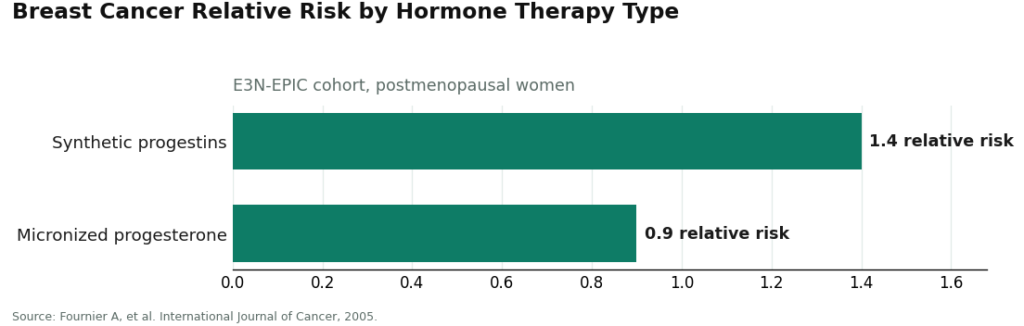
That’s a real difference and a sensible reason some clinicians prefer micronized progesterone. But a cohort study shows association, not proof of cause, and a relative risk of 0.9 is not the same as “protective” or “risk-free.” The fair reading: micronized progesterone appears to carry a more favorable breast signal than synthetic progestins in observational data. That’s a reasonable preference, not a guarantee against risk.
Dosing: why there’s no single right number
Dosing depends entirely on the purpose, which is why no single figure applies across the board. The FDA-approved oral capsule comes in 100 mg and 200 mg strengths [1]. In practice, menopause therapy tends to follow one of two patterns: a continuous regimen, where a woman on daily estrogen takes a lower dose of progesterone every day, or a cyclic regimen, where she takes a higher dose, often 200 mg, for a set number of days each month. That second pattern mirrors what PEPI used for endometrial protection, 200 mg daily for twelve days a month [2]. The bedtime timing many people follow is partly practical: oral progesterone tends to cause drowsiness, which is also part of why the sleep benefit shows up in the first place.
There’s a reason no specific dose gets recommended here: the right one depends on whether a uterus is present, what estrogen dose is being taken and by what route, whether the goal is lining protection or symptom relief, and how an individual responds. The North American Menopause Society’s 2022 hormone therapy position statement makes this point plainly, noting that risk and approach depend on the type, dose, route, and timing of hormone therapy and on whether a progestogen is used, and that decisions should be individualized [5]. In plainer terms, this is a conversation between a patient and a clinician, not a fixed recipe to copy from an article.
Approved versus compounded: a distinction worth keeping straight
One more piece of clarification, because marketing tends to blur it on purpose. There is exactly one FDA-approved oral progesterone: Prometrium and its generics [1]. Beyond that sits a much larger category of compounded progesterone, creams, troches, vaginal suppositories, custom-dose capsules, often marketed under the “bioidentical hormone therapy” umbrella. Both categories can contain the same, real progesterone molecule. They are not, however, the same regulatory object. Compounded drugs as a class are not FDA-approved, meaning the agency does not review them for safety, effectiveness, or quality before they reach a patient [6].
That doesn’t make compounded progesterone illegitimate. The FDA itself acknowledges that compounding meets genuine medical needs, for instance when a patient requires a dose or formulation the commercial product doesn’t offer [6]. The honest framing is simply that “compounded and prescribed by a clinician” and “FDA-approved” are two different things, and a provider worth trusting will tell a patient which one they’re getting rather than letting the word “bioidentical” carry the whole conversation.
The sensible path
Given all of that, the sensible path is straightforward: get the form and dose set by a licensed clinician who knows the full history, rather than picking one off a quiz or a marketing page. A telehealth provider like FormBlends operates this way, offering both the FDA-approved oral capsule and compounded forms, with a clinician reviewing history before anything is prescribed and a licensed pharmacy handling dispensing. There’s nothing to purchase here and no checkout to walk through. The point isn’t the name on the label. The point is that a hormone doing a genuinely protective job for the uterine lining deserves a real clinician making the call on form and dose, not a guess.
The short version
Progesterone is a hormone the body already makes, and in menopause care it carries out one job that’s genuinely critical and a few others that are worthwhile extras. The critical one, protecting the uterine lining during estrogen therapy, is backed by gold-standard trial evidence [2] and written directly into the FDA-approved label [1]. The sleep benefit is real, but modest [3]. The breast-safety edge over synthetic progestins is real, but observational, an association rather than proof [4]. Dosing isn’t one-size-fits-all; it depends on whether a uterus is present and what the treatment goal is, and the leading menopause guidance is explicit that therapy should be individualized [5]. And the approved capsule and the compounded creams, while capable of containing the identical molecule, remain two different regulatory categories [6]. Understanding those handful of facts puts a person ahead of most of what circulates online about this hormone.
Questions people actually ask
Is bioidentical progesterone the same as Prometrium? Prometrium is bioidentical. Its active ingredient is micronized progesterone, the same molecule the body produces, so the FDA-approved capsule and most compounded “bioidentical” progesterone share an identical compound [1]. The real dividing line isn’t chemistry, it’s regulation: Prometrium and its generics go through FDA review for dose and quality, while compounded versions don’t [6]. “Bioidentical” describes the molecule, not whether a product has been vetted by regulators.
If there’s no uterus, is progesterone with estrogen still necessary? The main reason to pair progesterone with estrogen is to protect the uterine lining from overgrowth, and without a uterus there’s no lining to protect [2]. That’s why estrogen alone is common after a hysterectomy. Any secondary benefit, like sleep, would be a separate discussion entirely, unrelated to the lining-protection rationale.
Why does oral progesterone usually get taken at bedtime? Oral micronized progesterone tends to cause drowsiness, so dosing it at night turns a side effect into a useful feature and keeps sedation out of the daytime hours. That same property lines up with the modest sleep improvement seen in postmenopausal women [3]. It’s a practical scheduling choice more than a strict pharmacological rule.
Does progesterone genuinely help with sleep, or is that mostly marketing? There’s real randomized evidence behind it. A 2021 systematic review and meta-analysis found that micronized progesterone improved several aspects of the sleep cycle and self-reported sleep, mostly in postmenopausal women [3]. The honest caveat: the effect is modest and was studied specifically in the menopause context, making it a genuine secondary benefit rather than a general sleep aid.
Is micronized progesterone actually safer for the breast than synthetic progestins? The observational data lean that direction. The large French E3N-EPIC cohort found higher breast cancer risk with synthetic progestins than with micronized progesterone, relative risks around 1.4 versus about 0.9 [4]. That’s a reasonable basis for a preference, but a cohort study shows association rather than causation, and a relative risk near 0.9 isn’t the same as protective.
How much progesterone do people typically take? It depends entirely on the goal, which is why there’s no universal number. The FDA-approved capsule comes in 100 mg and 200 mg strengths, used either as a lower continuous daily dose or a higher cyclic dose, such as the 200 mg for twelve days a month used in the PEPI trial for lining protection [1][2]. Major menopause guidance is explicit that type, dose, route, and timing should be individualized [5].
What is progesterone and where does it come from?
Progesterone is a steroid hormone produced naturally in the body, mainly in the ovaries after ovulation, with smaller contributions from the adrenal glands and, during pregnancy, the placenta. It belongs to a class called progestogens and works alongside estrogen to regulate the menstrual cycle, prepare the uterine lining for a fertilized egg, and support early pregnancy. Men produce it as well, though at much lower levels.
What is progesterone actually used for in medical treatment?
Clinicians prescribe progesterone most commonly to protect the uterine lining in women on estrogen therapy, to address irregular or absent periods, and to support early pregnancy in people with a history of loss. It also appears in some hormonal contraceptives and is being studied for sleep and mood applications, though evidence in those areas is still developing and not yet conclusive.
Does progesterone cause weight gain?
The evidence is mixed. Progesterone may modestly increase appetite and cause temporary fluid retention that shows up briefly on a scale. Synthetic progestins, which differ from bioidentical progesterone, are more consistently tied to weight changes in research. Plenty of people notice no meaningful change at all. Dose, delivery method, and individual metabolism all factor in, so sweeping claims about weight gain don’t hold up well under scrutiny.
What are the most common progesterone side effects, and how would someone know if a dose needs adjusting?
Common side effects include drowsiness, breast tenderness, bloating, and mood shifts, especially at higher doses. Oral progesterone is notably sedating because it converts to a compound that acts on GABA receptors in the brain, which is why many providers recommend taking it at night. If side effects feel disruptive, or the intended benefit isn’t showing up, that’s a fair reason to revisit dosing with a prescriber. Compounding pharmacies operating under physician supervision, FormBlends among them, can adjust dose and form with more precision than a fixed, one-size product allows.
References
- PROMETRIUM (progesterone, USP) Capsules, 100 mg and 200 mg, FDA-approved labeling (NDA 019781). Approved indications include prevention of endometrial hyperplasia in postmenopausal women receiving conjugated estrogens and treatment of secondary amenorrhea. U.S. Food and Drug Administration, Drugs@FDA labeling. https://www.accessdata.fda.gov/drugsatfda_docs/label/2009/019781s013lbl.pdf
- The Writing Group for the PEPI Trial. Effects of hormone replacement therapy on endometrial histology in postmenopausal women. The Postmenopausal Estrogen/Progestin Interventions (PEPI) Trial. JAMA, 1996. Cyclic micronized progesterone 200 mg/day, like other progestogen arms, kept endometrial hyperplasia rates near placebo, while unopposed estrogen produced a large excess. https://pubmed.ncbi.nlm.nih.gov/8569016/
- Nolan BJ, Liang B, Cheung AS. Efficacy of Micronized Progesterone for Sleep: A Systematic Review and Meta-analysis of Randomized Controlled Trial Data. Journal of Clinical Endocrinology & Metabolism, 2021. Micronized progesterone improved several aspects of the sleep cycle and self-reported sleep, predominantly in postmenopausal women.
- Fournier A, Berrino F, Riboli E, et al. Breast cancer risk in relation to different types of hormone replacement therapy in the E3N-EPIC cohort. International Journal of Cancer, 2005. Observational cohort; breast cancer relative risk approximately 1.4 with synthetic progestins versus approximately 0.9 with micronized progesterone.
- The North American Menopause Society. The 2022 hormone therapy position statement of The North American Menopause Society. Menopause, 2022. Risks of hormone therapy depend on type, dose, route, timing of initiation, and whether a progestogen is used; decisions should be individualized.
- U.S. Food and Drug Administration. Compounding and the FDA: Questions and Answers. Compounded drugs are not FDA-approved, meaning the agency does not review their safety, effectiveness, or quality before they are marketed; compounded drugs can serve important medical needs.
Written by Liam Farrell, consumer-health journalist. Last reviewed June 2026.
Not intended as medical guidance. Speak to a qualified provider about what is right for you.